Customer Engagement Platform: What It Is and How to Choose One
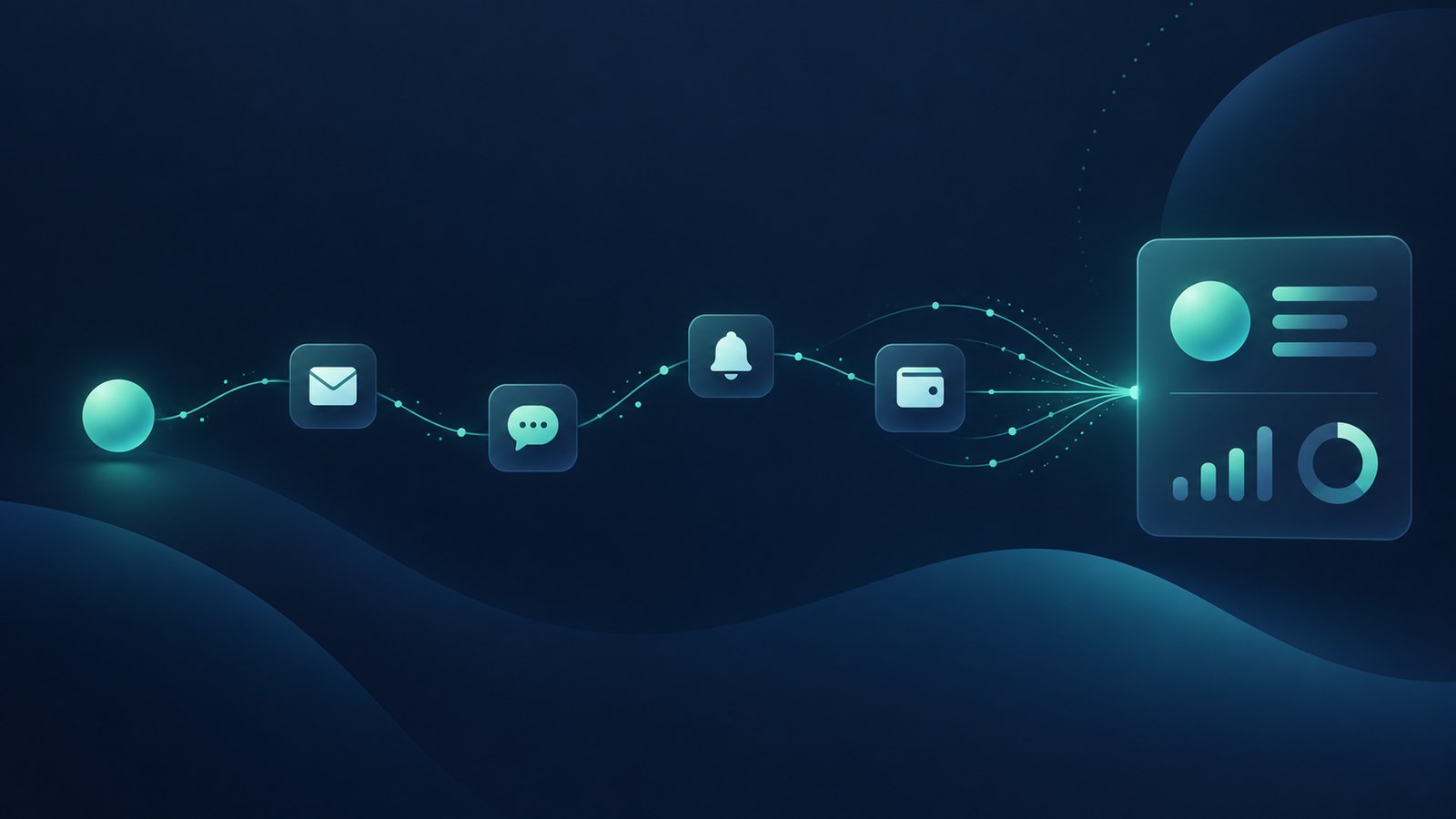
A customer engagement platform is the system lifecycle teams use to collect customer behavior, keep profiles and segments current, and send coordinated messages across email, SMS, WhatsApp, push, in-app and other channels from one place. It differs from a CRM, ESP or CDP because it handles the whole loop: who should hear from you, what they get, on which channel, when, and whether the message actually changed anything. If your team is choosing one, start with channel coverage: not every platform has mobile SDKs and solid in-app support, and many don't support WhatsApp or Viber, which can be primary channels in some markets. Then check the data model, journey guardrails, consent handling and measurement.
This matters because many brands overrate their own engagement. In Twilio's 2024 State of Customer Engagement Report, 84% of businesses said they provide "good" or "excellent" customer engagement, but only 54% of consumers agreed (Twilio). Better copy rarely closes that gap. Better data, timing and control usually do.
What a customer engagement platform does
At its core, a customer engagement platform keeps four things connected:
- Profiles and events. Website, app, store and support activity flows into one customer profile as it happens.
- Segments. Audience membership updates when behavior changes, rather than waiting for a nightly export.
- Journeys and campaigns. Triggers, delays, branches and channel steps run from the same data, with consent, frequency and quiet-hour rules applied before every send.
- Measurement. Holdout groups, funnels and revenue attribution show which messages changed behavior and which simply happened to come before a purchase.
A quick test: if your team still exports a CSV to decide who gets the next message, the data is there, but nothing acts on it while the customer is still paying attention.
Consumers notice the difference. In Adobe's 2025 AI and Digital Trends research, 71% of consumers said they expect brands to anticipate their needs with relevant information or offers, but only 34% said the brands they deal with actually do this (Econsultancy summary of the Adobe report).
Customer engagement platform vs. CRM, ESP and CDP
Much of the confusion when buying comes from category overlap. Here's how the four typically differ:
CRM
- Main job: Track contacts, accounts, deals and sales activity
- Journey orchestration: Limited, usually sales-focused
- Typical owner: Sales and account teams
ESP (email service provider)
- Main job: Build and deliver email campaigns
- Journey orchestration: Mostly email-first, often batch
- Typical owner: Email marketers
CDP (customer data platform)
- Main job: Unify customer data and pass audiences to other tools
- Journey orchestration: Usually limited; activation happens elsewhere
- Typical owner: Data and marketing ops teams
Customer engagement platform
- Main job: Profiles, real-time segments, cross-channel journeys and analytics
- Journey orchestration: Native, across channels
- Typical owner: Lifecycle, CRM and growth teams
The lines blur in practice. Plenty of ESPs have added SMS, and some CDPs offer basic journeys. The useful question isn't which label a vendor uses. It's where the decision about the next message is made, and whether that decision uses live data.
Why tool sprawl costs lifecycle teams
When messaging, data and reporting live in separate systems, teams spend their time reconciling lists and arguing over which dashboard is right. Tests slow down, suppression logic gets copied in three places, and nobody can say for sure whether a journey drove a conversion. If answering one question about a journey takes three tools, the stack is costing you time and trust.
Core capabilities to look for
Real-time data and identity
A cart reminder sent the next morning is a generic follow-up, not a timely nudge. Look for event ingestion through SDKs (web, iOS, Android) and a REST API, plus native store integrations. Profiles should update within the journey's timeframe, and anonymous browsing activity should merge into the known profile once someone logs in or buys.
Journeys with guardrails
Visual journey builders are standard. The guardrails are where platforms differ. Check for:
- Triggers based on custom events, segment entry, API calls, schedules and inbound replies
- Quiet hours based on each recipient's time zone
- Workspace-wide frequency limits that apply to every journey, not just one
- Holdout or control groups built into the journey
- Versioning, so editing a live journey doesn't disrupt it for people already in it
Channels that share one set of rules
Email, SMS, WhatsApp, push, in-app, webhooks and ad audience sync should all read from the same profile and consent record. Wallet passes are worth asking about if you run loyalty programs, ticketing or offers. Apple Wallet passes can carry time and location relevance so they appear on the lock screen at the right moment (Apple Wallet developer guide).
AI that works inside your rules
AI is useful for drafting content, suggesting segments, proposing journeys and choosing a message, channel or send time for each customer. The test is control. Drafts should wait for human approval. Choices for each customer should stay within the consent, frequency and quiet-hour rules your team sets. Measure lift against a control group so you can see when AI isn't helping. Also ask which AI features come with each plan, since vendors often tier them.
Data that flows back out
Your analysts will want raw events in the warehouse. Look for continuous streaming to destinations like Snowflake, BigQuery, S3 or Kafka, not just CSV exports.
Example: a consent-aware replenishment journey
Here's a journey you can adapt. Say a skincare brand sells a moisturizer that usually lasts about 60 days. The goal is a timely reorder reminder that respects consent and doesn't nag.
Segment definition: "Due for moisturizer reorder"
last_purchase_sku= moisturizer SKUdays_since_last_purchasebetween 45 and 55- No order containing that SKU since
last_purchase_date email_marketing_consent= true ORsms_marketing_consent= true- Not on a suppression list (unsubscribed, bounced, complained)
Data fields to store on the profile or event: customer ID, product SKU, last purchase date, estimated depletion date, consent status and timestamp per channel, time zone, preferred channel (if known), suppression status.
Steps and timing (adjust to your product's real usage cycle):
- Trigger (day 0): Customer enters the segment. Hold out 10% as a control group that gets no reminder, so you can measure lift later.
- Consent check: Branch by channel. If email consent is active, continue to step 3. If only SMS consent exists, skip to step 5. If neither is active, exit.
- Email (day 0, within the customer's allowed hours): A short reminder that the product is likely running low, with a one-click reorder link. No invented urgency or fake scarcity.
- Wait 3 days, then check: If the customer reordered, exit and start the post-purchase flow. If they clicked but didn't buy, wait 2 more days. If there's no engagement, continue.
- SMS (day 3 to 5), only with SMS opt-in: A one-line reminder with the reorder link and opt-out instructions. Respect quiet hours and your weekly frequency limit. If a send would fall within quiet hours, delay it.
- Exit (day 10): Anyone who hasn't reordered leaves the journey. Don't loop them back in for at least one cycle.
- Measure (day 30): Compare reorder rate and revenue per recipient against the holdout, not against last month.
Consent rules to build in
- Email and SMS consent are separate. The UK ICO's guidance says to ask for consent for each type of electronic marketing separately, since someone may want your emails but not your texts (ICO PECR guidance).
- WhatsApp needs opt-in too. Meta requires businesses to get opt-in before messaging people on WhatsApp, and to state clearly which business the person is agreeing to hear from (Meta for Developers).
- Opt-outs have deadlines. In the US, the CAN-SPAM Act requires commercial email senders to honor opt-out requests within 10 business days, and the opt-out mechanism must keep working for at least 30 days after sending (15 U.S.C. § 7704). In practice, apply unsubscribes across all journeys right away. Don't treat the legal deadline as your target.
- Log suppressions with context. Record the channel, reason, source journey and timestamp, so you can answer "why didn't this person get the message?" and "why did they?"
SMS rules vary by country and are strict in many markets, so check local requirements with your legal team before launching an SMS step.
How to evaluate customer engagement platform vendors
Use this checklist in demos. Ask vendors to show each item in the product, not on a slide.
Pricing basis
- What to ask: Are fees tied to stored contacts, tracked events, messages sent or profiles actually reached? Is messaging billed separately?
- Why it matters: Contact-based pricing makes dormant records expensive. Event-based pricing can penalize good tracking.
Data model
- What to ask: How quickly do events update profiles and segments? How are anonymous and known profiles merged?
- Why it matters: Stale data means late or wrong messages.
Guardrails
- What to ask: Where are frequency limits, quiet hours and consent set? Do they apply across every journey and campaign?
- Why it matters: Rules set per journey get missed.
AI controls
- What to ask: What does AI draft versus decide? What needs approval? Which features are included in each plan?
- Why it matters: You need to know what goes out without a human check.
Measurement
- What to ask: Are holdouts native? How is revenue attributed across campaigns and journeys? Are bot opens and clicks filtered by default?
- Why it matters: Without these, you can't tell lift from noise.
Data export
- What to ask: Can you stream events to your warehouse continuously?
- Why it matters: Analysts need raw data, and you need a way out later.
Access and security
- What to ask: SSO, SAML, MFA, role permissions, audit logs, IP allowlisting
- Why it matters: These are standard requirements for most security reviews.
Migration
- What to ask: What help does the vendor provide, and what does your team need to do?
- Why it matters: Migration scope is often vague until it's too late.
On pricing, Joryio (a customer engagement platform built by a team that spent years running these platforms for brands) is one example of a profile-based model. Platform fees are based on Engaged Profiles, meaning customers who received a delivered message that month. Stored contacts and tracked events don't count, and messaging is billed separately. Whichever vendor you consider, model your own numbers: how many customers you actually message each month compared with how many you store.
Measuring engagement without fooling yourself
Open rates are a weak signal now. Apple's Mail Privacy Protection hides whether someone actually opened an email by loading content privately in the background, so many recorded opens aren't real reads (Apple Support). Security scanners can also trigger opens and even clicks automatically. If send-time, subject-line or frequency tests optimize for raw opens, they can lead to poor decisions.
A more reliable setup:
- Use holdouts for every major journey. Compare conversion and revenue per recipient against people who got nothing.
- Filter machine activity. Exclude opens and clicks your platform identifies as bot activity before comparing variants.
- Attribute once. Each conversion should be credited once across campaigns and journeys, not claimed by every message that reached the customer.
- Pick one primary metric per test. Revenue per recipient or conversion rate beats a dashboard of 12 metrics.
Migrating platforms without breaking consent
Most migrations go wrong when teams treat them as a software swap instead of an operational change. Use this checklist:
- Export profiles with consent intact. Keep email, SMS and WhatsApp permissions as separate fields, with opt-in timestamps, source and, where available, the policy or wording version.
- Move suppression lists first. Import unsubscribes, bounces and complaints before any journey goes live in the new platform.
- Inventory active journeys. List every live flow, its trigger, its volume and its revenue. Rebuild the highest-value ones first, and retire the ones nobody can explain.
- Recreate frequency and quiet-hour rules globally. Don't rebuild them journey by journey.
- Run in parallel carefully. If both systems send at once, make sure a customer can't be enrolled in the same flow twice.
- Validate data flows. Confirm event tracking, identity merging and warehouse streaming before switching off the old system.
- Warm up sending gradually. Move volume over in stages, especially if you're changing sending domains or IPs.
If you're moving from another platform, Joryio's migration process explains how the team guides customers through planning, data imports, journey rebuilds and pre-launch checks.
Frequently asked questions
Is a customer engagement platform the same as a CRM?
No. A CRM tracks contacts, accounts and sales activity. A customer engagement platform uses behavioral data to maintain segments, run cross-channel messaging and journeys, and measure their impact. Many companies run both, with the CRM syncing customer attributes into the engagement platform.
Do we still need a CDP if we have a customer engagement platform?
It depends on how many tools need the same audiences. If most activation happens in your engagement platform and your warehouse is the source of truth for analytics, you may not need a separate CDP. If you feed audiences to many tools beyond messaging, a CDP or warehouse-native setup can still make sense.
How do we prove personalization is working?
Use a holdout group and one primary outcome, such as revenue per recipient or conversion rate. Compare the personalized group against the holdout over a full purchase cycle, and filter bot activity before reviewing the results.
Where should AI fit in our workflow?
Let AI draft content, segments and journeys for your team to review. Let it personalize the message, channel or send time only within rules you set, such as consent, frequency limits and quiet hours. Measure lift against a control group so you can tell when it helps and when it doesn't.
How long does a platform migration take?
It depends on data volume, the number of integrations, journey complexity and how much time your team can commit. Plan the order of work, move consent and suppression data first, and launch in stages rather than switching everything over in one day.
If you're evaluating a customer engagement platform for your team, see how Joryio works or talk to the Joryio team about your current setup.